Table of Contents
Some movies are fun while you’re watching them.
Some are impressive.
And then there are movies that somehow follow you home.
Interstellar is one of those movies.
You can finish it, put your phone down, and think you’re done.
Then a few hours later you’re thinking about the ending.
Or the bookshelf.
Or that scene with Cooper.
Or the fact that the movie somehow managed to make a conversation about time feel more painful than most dramatic movies ever do.
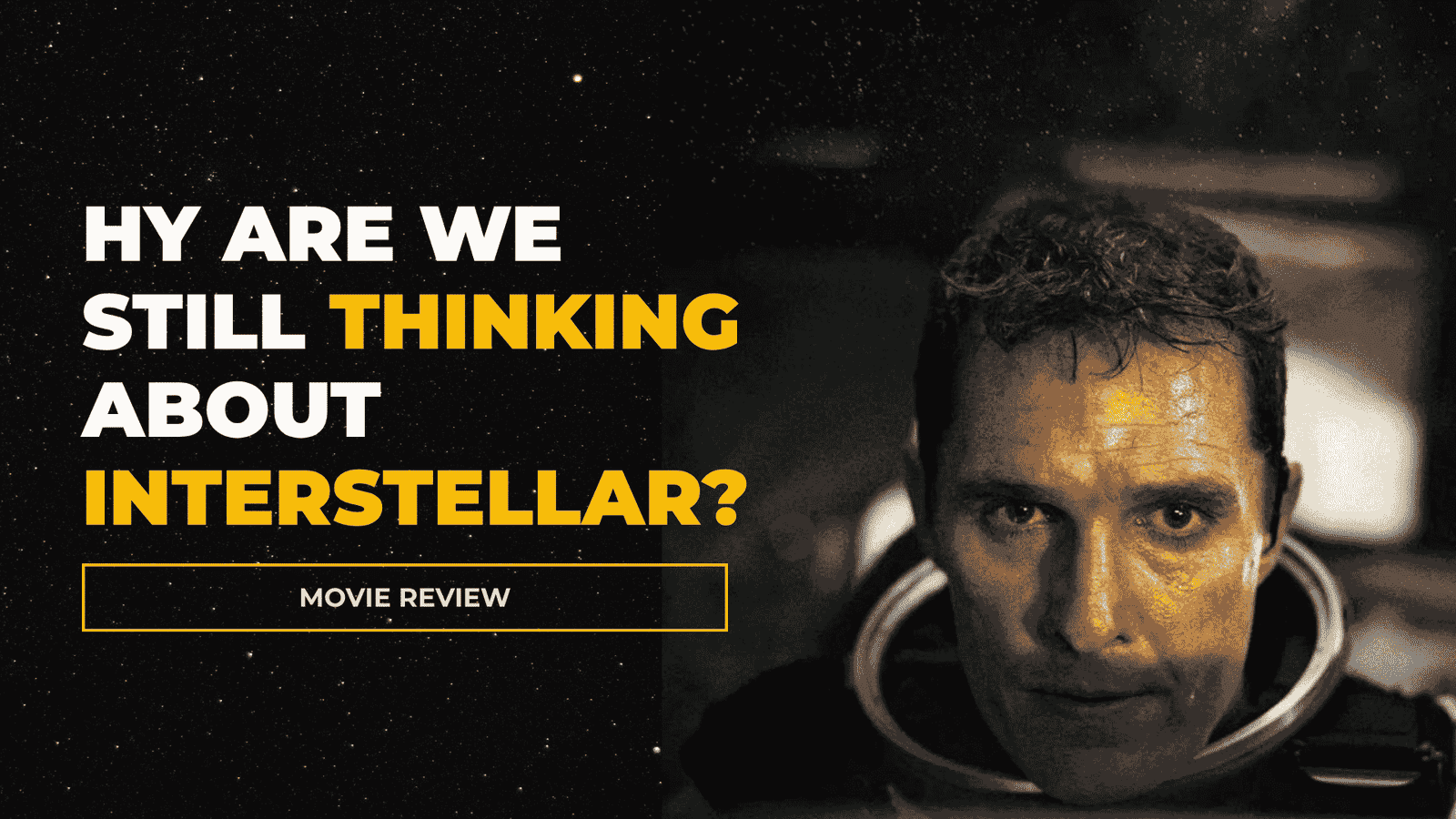
That’s what makes Christopher Nolan’s Interstellar so special.
It looks like a huge science-fiction movie about saving humanity.
But underneath all the wormholes, black holes and impossible distances, it’s really a story about one very simple thing:
A father trying to get back to his children.
It Isn’t Really About Space
This is probably the biggest misunderstanding about Interstellar.
Yes, the movie is packed with science-fiction ideas.
There’s a dying Earth.
There’s a wormhole near Saturn.
There are strange planets.
There’s a black hole called Gargantua.
There’s time dilation.
There’s an entire sequence where minutes for Cooper can mean years for his family back home.
But take all of that away and the emotional core is still there.
Cooper doesn’t leave Earth because he wants to become a hero.
He leaves because humanity needs another option.
And that decision costs him something that money, intelligence or technology can’t buy back.
Time with his children.
That’s where the movie really hurts.
Cooper’s Biggest Problem Isn’t the Mission
Matthew McConaughey’s Cooper is often remembered as the astronaut who went through a black hole.
For me, that’s not what makes him interesting.
His biggest problem is guilt.
He knows he’s leaving his children behind.
He knows they might grow up without him.
And he knows there’s a chance he may never see them again.
The movie doesn’t pretend that’s an easy decision.
That’s why the famous video-message scene works so well.
Cooper watches his children grow up through recorded messages while he remains almost the same age.
He misses birthdays.
He misses conversations.
He misses years.
And suddenly the science-fiction concept becomes painfully personal.
Imagine leaving home for what feels like a short mission and coming back to find that your child is now older than you.
That’s horrifying.
The Movie Makes Time Feel Like an Enemy
Most movies treat time as something that simply passes.
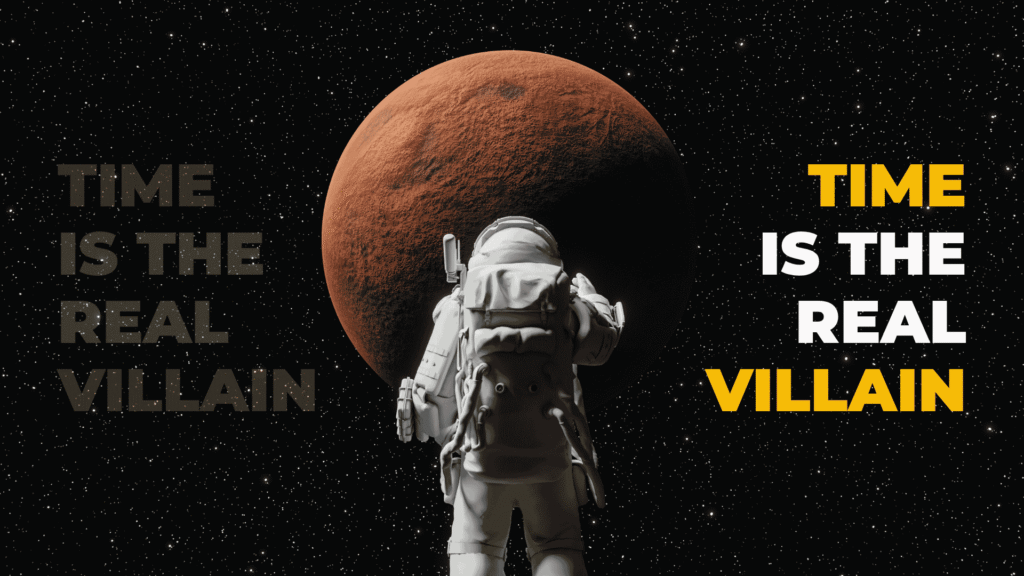
Interstellar turns it into the villain.
The famous time-dilation sequence on Miller’s planet is a perfect example.
Cooper and the others aren’t just fighting the planet.
They’re fighting the clock.
Every minute matters.
And every minute they lose could mean years for the people waiting back on Earth.
That’s a terrifying idea because there isn’t anything Cooper can punch or shoot.
He can’t defeat time.
He can only keep moving.
NASA explains that real interstellar space is vastly different from the dramatic worlds shown in science fiction, but the movie uses real concepts such as gravitational effects and extreme distances as the foundation for its story. NASA’s own material on interstellar exploration also highlights just how difficult it would be for humanity to travel beyond our solar system.
That’s part of why the science in Interstellar feels convincing.
It gives the fantasy something real to hold onto.
And Then There’s Gargantua
The black hole is one of the most unforgettable parts of the movie.
It’s enormous.
It’s beautiful.
And somehow it doesn’t look like the usual Hollywood version of a black hole.
That’s because Nolan wanted the science to matter.
The visual effects team worked with physicist Kip Thorne to make the depiction of the black hole and its surrounding accretion disk as scientifically grounded as possible.
The result became one of the movie’s defining images.
But again, the visual isn’t really the point.
The black hole represents the distance between Cooper and home.
The farther he travels, the harder it becomes to return.
And eventually, that distance becomes almost impossible to understand.
The Movie’s Most Emotional Scene Isn’t an Explosion
It’s Cooper watching the messages from his children.
That’s the scene that gets me.
There’s no giant spaceship battle.
No huge visual effect.
Just a man sitting in front of a screen realizing that his children have grown up without him.
And the movie gives the scene time to breathe.
It doesn’t rush to the next action sequence.
It lets Cooper sit with what he’s lost.
That’s something Interstellar does surprisingly well.
It knows when to be enormous.
But it also knows when to become quiet.
Is the Ending Too Complicated?
This is probably the biggest complaint people have about Interstellar.
The final act gets weird.
Very weird.
Cooper enters the black hole and ends up in a strange structure where he can interact with different moments in time.
Then there’s the whole idea of gravity, the bookshelf and the message to Murph.
It’s definitely the kind of ending that makes you pause the movie and say:
“Wait… what just happened?”
But emotionally, I think it works.
Because the movie has been building toward Cooper and Murph finding each other again from the beginning.
The science is complicated.
The emotional idea isn’t.
A father wants his daughter to know that he never abandoned her.
And a daughter who spent years believing her father left her finally understands what actually happened.
That’s the part that matters.
The Real Reason Interstellar Still Works
It’s not the space travel.
It’s not the black hole.
It’s not even the science.
It’s the relationship between Cooper and Murph.
The movie takes a gigantic idea, humanity trying to survive, and puts it inside a very small relationship.
A father.
A daughter.
And years they can never get back.
That’s why the movie still works more than a decade after its release.
Technology will change.
Visual effects will improve.
We’ll probably get hundreds of new sci-fi movies.
But that feeling of realizing you’ve lost time with someone you love?
That’s not going anywhere.
Is Interstellar Worth Watching?
Absolutely.
Even if you’re not a huge science-fiction fan.
Actually, especially if you’re not.
Because Interstellar isn’t asking you to understand every scientific concept before you can enjoy it.
You can simply watch it as a story about people trying to survive, people making impossible choices and a father desperately trying to get home.
And yes, some of the science will make your brain hurt.
That’s part of the fun.
You might finish the movie and immediately search for an explanation of the ending.
You might start reading about black holes.
You might suddenly find yourself watching NASA videos at 2 a.m.
And honestly?
That’s a pretty good sign for a movie.
Final Verdict
Interstellar – 9.5/10
Romit Sensei – 9.5/10
It’s ambitious, emotional, visually incredible and occasionally confusing.
But that’s also why it has stayed with people for so long.
It isn’t perfect.
Some dialogue can feel overly dramatic.
The final act asks you to accept some very big ideas.
And yes, the movie absolutely knows how to make you cry.
But when the credits roll, you’re left with something more memorable than a cool space adventure.
You’re left thinking about time.
About family.
About the people you love.
And about how terrifying it is to realize that no matter how advanced humanity becomes…
we still can’t get yesterday back.